

Selected Paintings
Opus V · Fumus Vitae
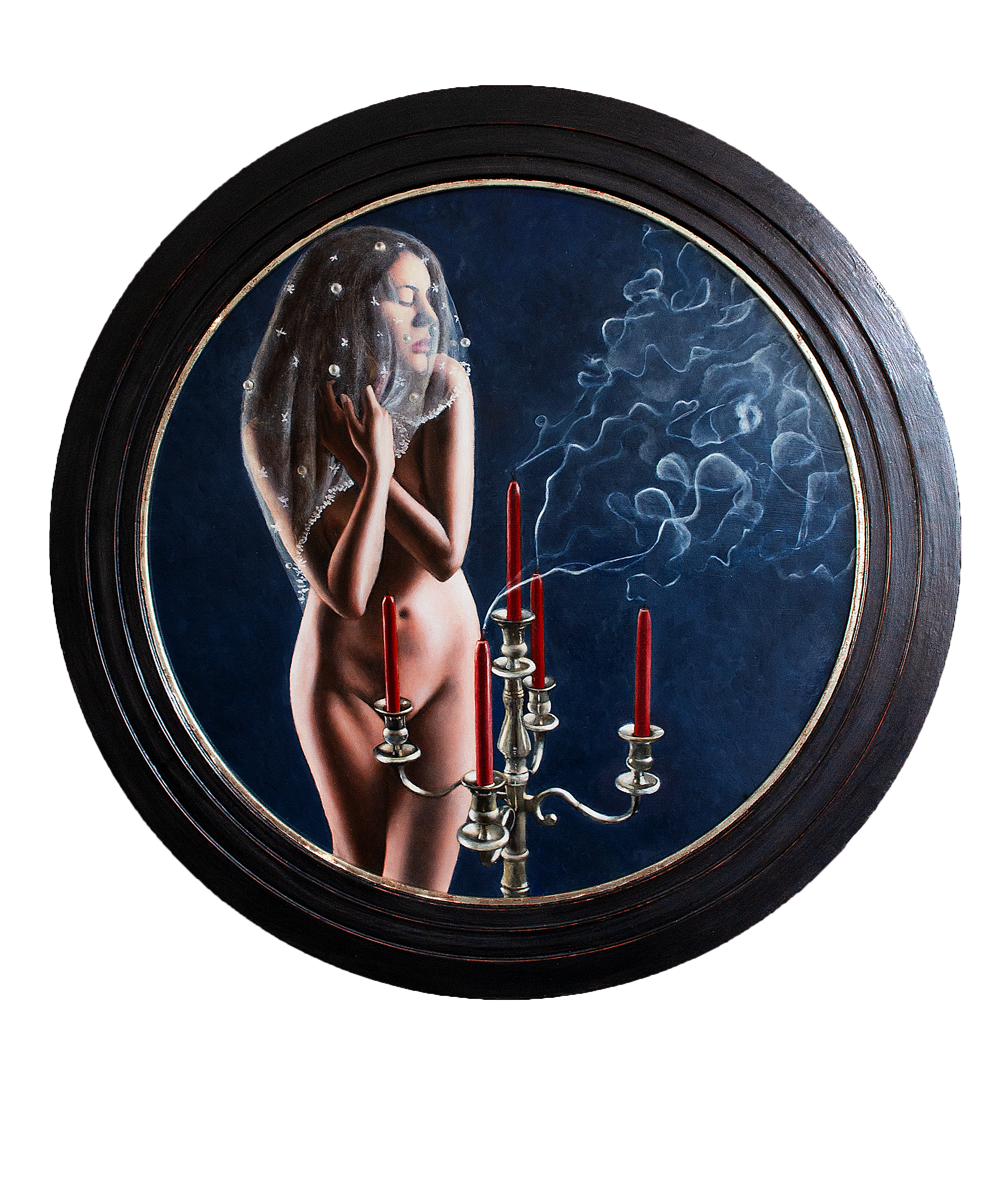
Opus V · Fumus Vitae
2025
Egg tempera and oil on circular panel
Diameter: 75 cm
Private Collection, Belgium
Frame: Artist-designed and handmade frame, water gilded by the artist
Fumus Vitae continues several concerns central to this practice: the female figure, formal concentration, and the careful orchestration of light, symbol and atmosphere. The circular format intensifies the sense of enclosure, while smoke evokes a state of transition rather than a fixed narrative. Executed in egg tempera and oil, the work invites sustained looking through a restrained image in which presence emerges gradually.
Opus II · The Girl with the Mysterious Eyes
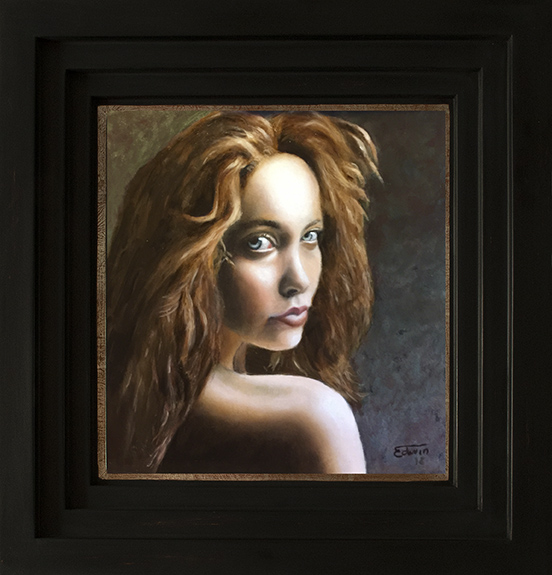
Opus II · La Fille aux Yeux Mystérieux
2018
Egg tempera and oil on panel
31 × 33 cm
Private Collection, France
La Fille aux Yeux Mystérieux is an intimate tronie in which the turn of the head, the shifting gaze and the controlled fall of light create a quiet exchange with the viewer. The portrait does not depend on drama, but on restraint: character emerges through small changes of surface, expression and attention.
OPUS III: The Forbidden Fruit
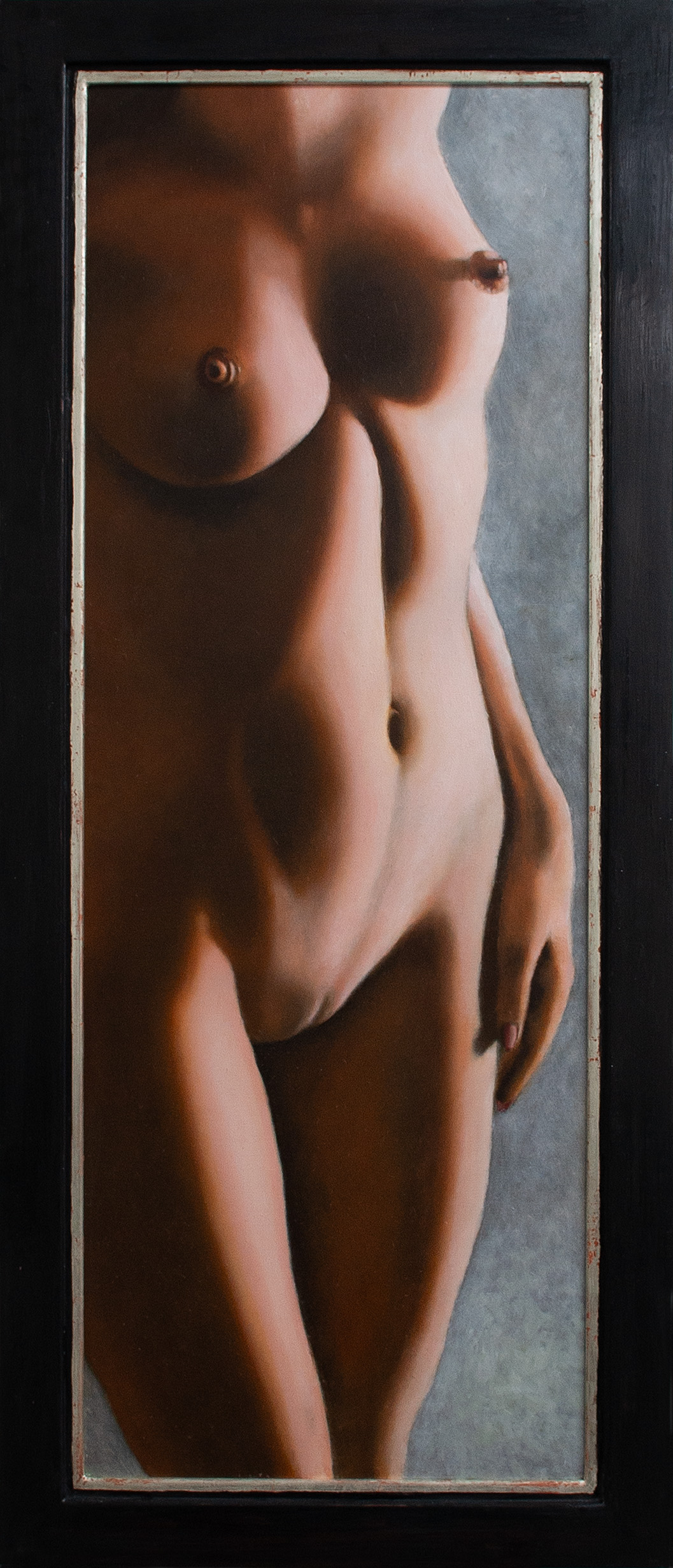
Opus III · Le Fruit Défendu
2025
Egg tempera and oil on panelAvailable
Frame: Artist-designed and handmade frame, water gilded by the artist
Le Fruit défendu is structured as a secular icon in which frontality, restraint and concentrated presence take precedence over narrative. Rather than fixing the meaning of the forbidden, the work reconsiders it through a contemporary image of embodiment, vulnerability and quiet gravity. Executed with a reduced formal language, the painting relies on stillness, proportion and control to hold attention.
OPUS IV Vermilion Presence
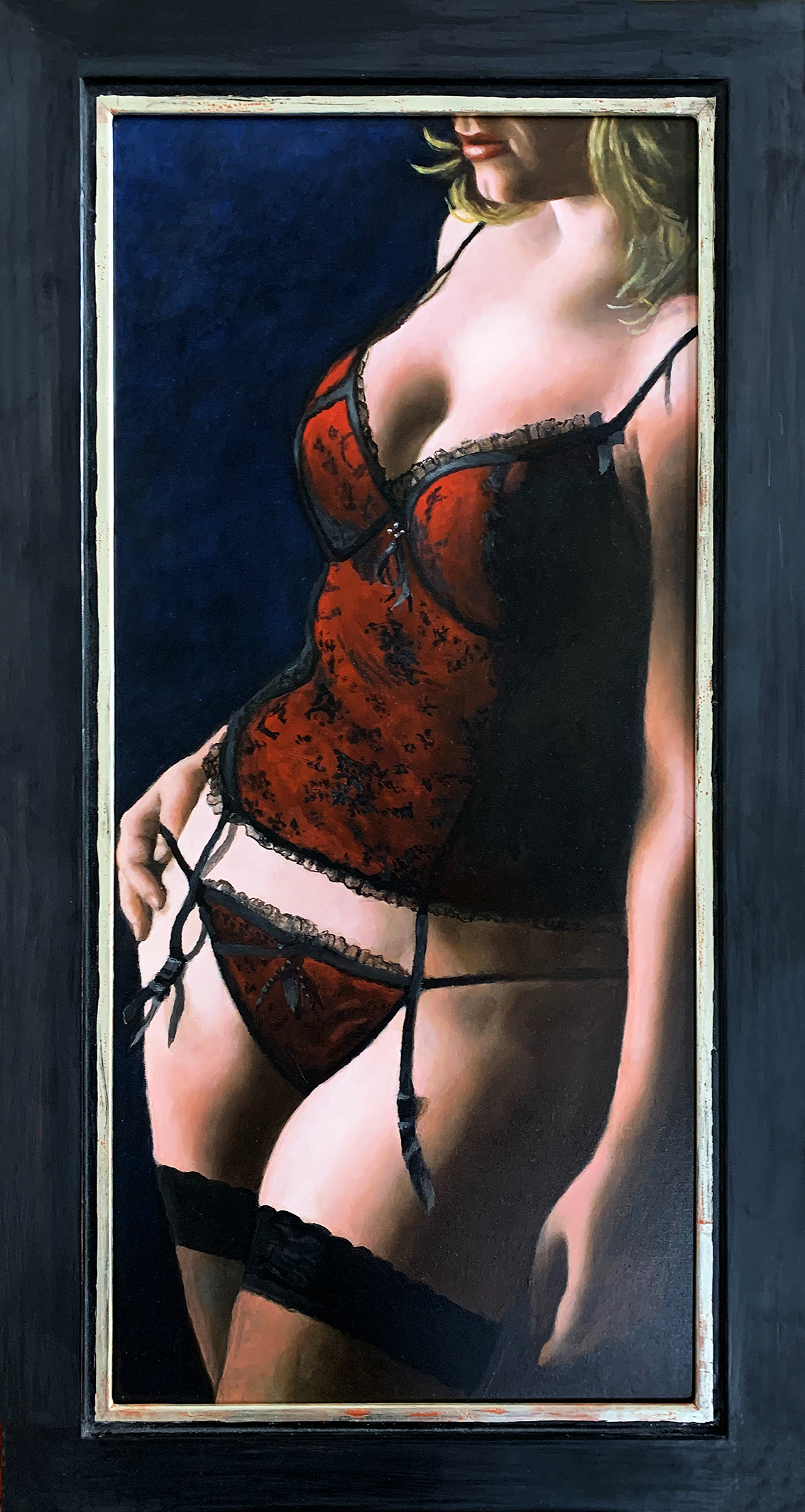
Opus IV· Vermilion Presence
2019
Egg tempera and oil on panel
31 × 70 cm
Available
Frame: Artist-designed and handmade frame, water gilded by the artist
Whispers of Temptation is built around suggestion rather than declaration. Cropped closely and held in a narrow vertical format, the figure is approached through partial revelation, creating an image in which intimacy is shaped by restraint. The work does not dramatise desire, but concentrates it into surface, proportion and pause. Its force lies in what is withheld as much as in what is shown.
Opus I · The Venice Girl triptych
A three-panel work structured around the motif of the Venetian mask, in which concealment gradually gives way to greater composure
Panel I · Venice Girl I
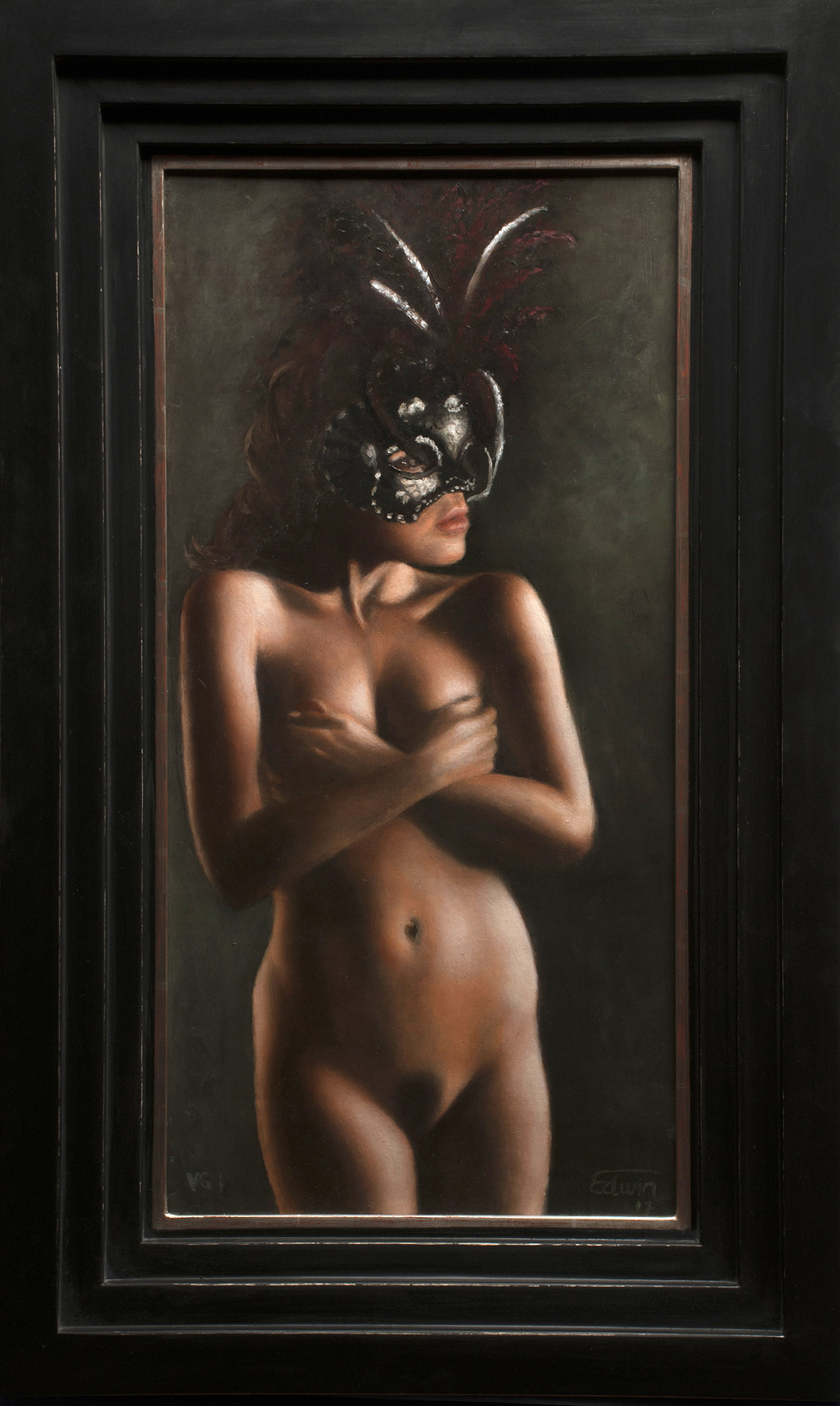
Panel I · Venice Girl I
2017
Egg tempera and oil on panel
30 × 60 cm
Private Collection, UK
Venice Girl I is built around inwardness and restraint. The Venetian mask functions not simply as disguise, but as a threshold, allowing the figure to remain partially withheld. Cropped closely and held in a controlled stillness, the painting draws its tension from what is protected as much as from what is revealed.
Venice Girl II
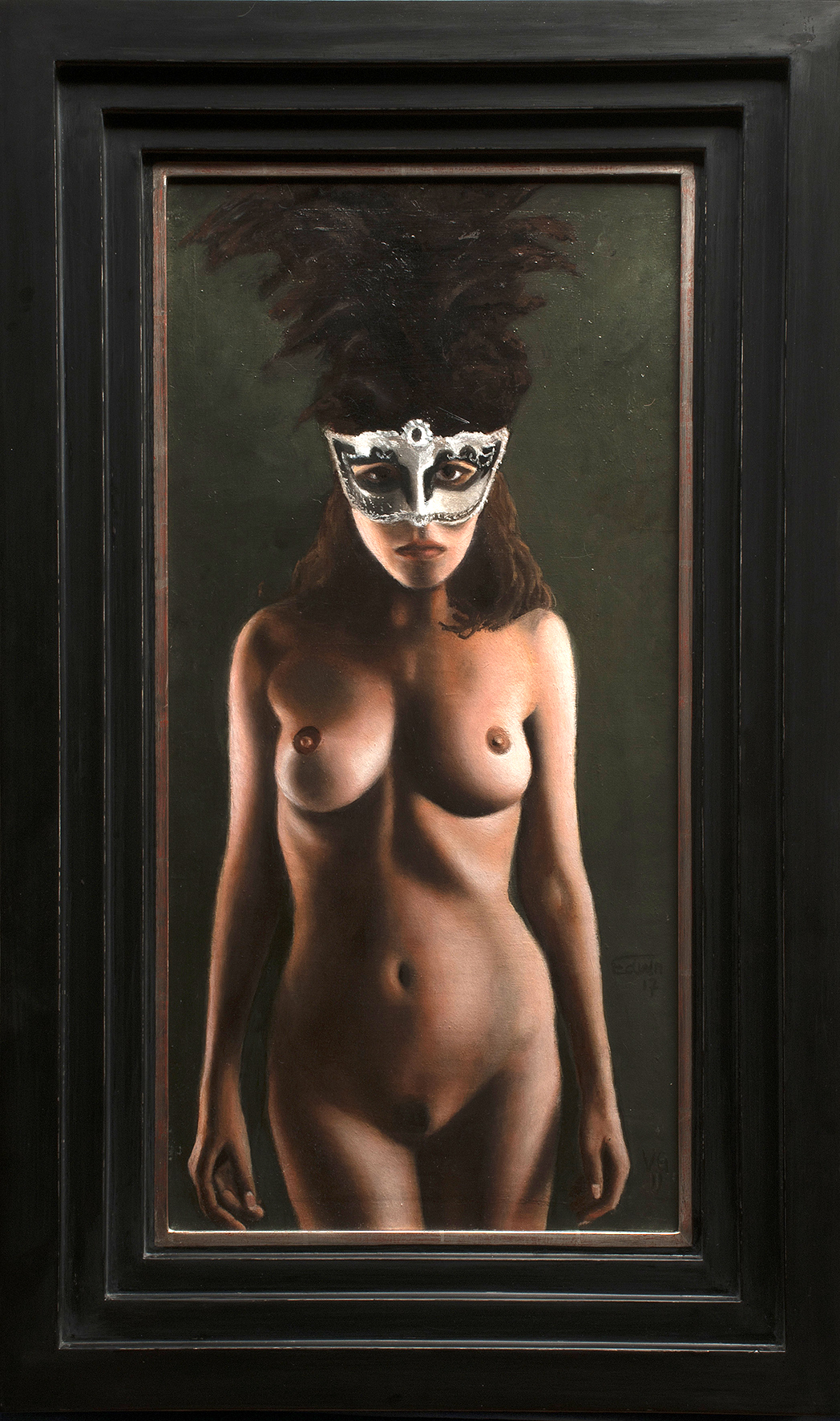
Panel II · Venice Girl II
2017-2018
Egg tempera and oil on panel
30 × 60 cm
Private Collection, UK
Venice Girl II marks a quiet shift in the triptych. The guardedness of the first panel begins to loosen, and a greater composure enters through posture, light and the relation between concealment and display. The image remains restrained, yet carries a more self-possessed presence.
Venice Girl III

Panel III · Venice Girl III
2017-2018
Egg tempera and oil on panel
30 × 60 cm
Private Collection, UK
Venice Girl III brings the triptych to its most resolved state. The figure appears more unified and assured, no longer defined primarily by concealment but by poise. What began as guardedness is here transformed into presence, giving the work its clearest sense of equilibrium and completion.
Seinsuelle

Seinsuelle
2019
31 × 33 cm
Egg tempera and oil on linen mounted on panel
Seinsuelle is a compact study of the female form in egg tempera and oil. The work concentrates on contour, surface and restrained intimacy, treating the body not as spectacle but as a study in presence, proportion and light.
Materials and Process
These paintings are built on fine Flemish linen mounted to panel and prepared with multiple layers of traditional gesso. The surface is developed through egg tempera, underpainting and thin oil passages, allowing light to move through the image rather than rest only on its surface.
Informed by IJpeij’s background in molecular chemistry and his sustained study of Old Master technique, the works are approached as constructed objects: image, support, ground, paint surface and frame forming a single material whole.
Commissions and Enquiries
Questions about a work, availability or commissions are welcome.
For enquiries, please get in touch.
A practice rooted in Old Master discipline and material intelligence
Before devoting himself fully to painting, Edwin IJpeij worked as an inventor in molecular chemistry. That analytical way of thinking remains present in the studio, where each work is approached not only as an image, but as a constructed object.
Support, ground, underpainting, paint surface and frame are considered in relation to one another. Each stage is developed with attention to material compatibility, optical depth and long-term stability.
Support and ground
The paintings are built on panel, often with fine Flemish linen mounted to the surface. The support is sealed and prepared with multiple layers of traditional gesso, creating a smooth, absorbent ground capable of receiving the slower construction of egg tempera and oil.
This ground is not merely technical. It determines how light enters the surface, how detail can be held, and how the image may develop over time.
Underpainting and colour
The image is first established through drawing and underpainting. In egg tempera, the structure of light, shadow and volume is carefully set before the slower passages of oil are introduced.
Colour is then built gradually through thin layers, allowing light to move through the paint film rather than remain only on the surface. This layered method gives the work its clarity, stillness and controlled luminosity.
Pigments and permanence
In earlier years, IJpeij studied and worked with historic pigments such as lead white, genuine Naples yellow and vermilion. Drawing on his background in chemistry, he later developed safer contemporary pigment combinations that evoke the optical character of these traditional materials while avoiding their toxicity and certain long-term material risks.
The result is a painting surface with depth, clarity and luminosity: one that acknowledges the material intelligence of Old Master painting while meeting contemporary expectations of safety, durability and technical care.